









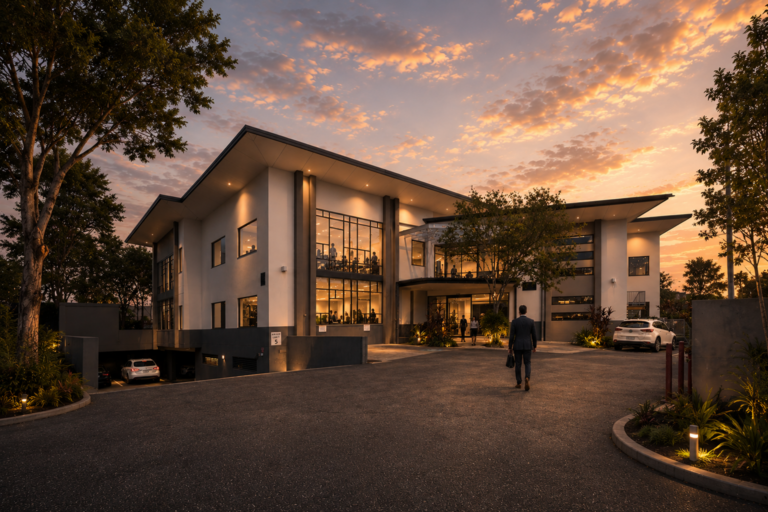




























Industry House at 10 Binara Street in Canberra's CBD, a five-star NABERS tower of about 25,000 sqm that last traded for $151.7 million, could lose its long-standing federal tenant. Real estate industry sources have told the Canberra Times the Department of Industry, Science and Resources is among the agencies most likely to move out. The reason is a Commonwealth energy rule that now shuts the building out of any new long-term government lease.
Industry House is not a tired building. It was an energy leader when the department moved in. That is what makes this story worth watching for every Canberra office owner, investor and agent: the goalposts for government tenants have moved and a rating that was once best in class is no longer enough.
Industry House at a glance
- Asset: Industry House, 10 Binara Street, Canberra City (Civic) ACT 2601
- Built: 2006
- Size: about 25,000 sqm, including retail and childcare space
- Energy rating: five-star NABERS
- Main tenant: the Department of Industry, Science and Resources (DISR), whose national office is at the address
- Last sale: $151.7 million in 2013 to UK-based Brompton Asset Management, at a reported 7.5 per cent yield
- The issue: new Commonwealth office leases longer than four years now need a NABERS Energy rating of at least 5.5 stars
Why a five-star building is suddenly on the wrong side of the line
From 1 July 2025 the Commonwealth's energy policy for its own operations changed the rules for office leasing. Agencies signing a new lease of more than four years must now take space in a building rated 5.5 stars or higher under NABERS Energy. Industry analysis of the policy puts the threshold at tenancies of 1,000 sqm or more of net lettable area and notes it applies to departments and agencies other than defence and security.
Industry House holds a five-star rating. On paper that is only half a star short. In practice it means a department sitting in the building cannot sign a fresh long-term lease there under the current policy. The rule is part of the Australian Public Service's push towards net zero government operations by 2030. A further step that took effect in July 2026 points agencies towards all-electric office space for new leases.
There is a quirk in how ratings are shown that matters here. NABERS publishes ratings in half-star steps and rounds down. A building that scores 5.4 stars is advertised as five stars. Agents in Canberra have suggested the number of buildings sitting just under the 5.5 line is probably larger than the published figures suggest.
The tenant: what we know about DISR's lease
Public detail on the department's current occupancy is thin. What has been reported is that December 2026 marks five years since the department's original lease at Industry House expired. When the building sold in 2013 it was less than halfway through a 15-year Commonwealth lease, which lines up with a lease that began around the time the building was completed.
A DISR spokesperson told the Canberra Times that any future leasing would follow the usual whole-of-government processes. The department also has a long facilities management contract in place. Evolve Facility Management signed a $274.6 million deal in 2024 to run DISR's facilities services through to 2030, with an option to extend to 2034. That contract covers services, not the building itself, so it does not lock the department into Industry House.
Nothing has been announced. The reporting is based on industry sources pointing to DISR as one of the most likely agencies to relocate. It is a warning sign for the asset rather than a confirmed move.
A short history of 10 Binara Street
Industry House was completed in 2006 as a purpose-built home for the federal industry portfolio. CorVal bought it for $123 million in 2009 and sold it four years later to Brompton Asset Management for $151.7 million. That 2013 deal, brokered by JLL, was the largest Canberra office transaction of the year. Brompton already owned the nearby 255 London Circuit at the time.
The building offered what investors wanted back then: a long Commonwealth lease, a central Civic location and an energy rating well ahead of most of the market. Thirteen years on, two of those three strengths are still in place. The third has been overtaken by policy.
The owner's view
For whoever holds Industry House the choice is not simple. The Commonwealth has been clear that decisions about upgrading buildings previously tenanted by government are commercial decisions for the landlord. In other words, the government will not fund the gap.
Lifting a building from a low five-star result to 5.5 stars is not always just a matter of new plant. JLL's Tim Mutton has pointed out that the jump often depends on things an owner cannot control, such as the building's aspect or how much natural light it gets. For a tower of around 25,000 sqm, an upgrade program could mean chillers, controls, lighting, glazing and metering, plus a decision on electrification given the all-electric direction of the policy.
The alternative paths are a re-lease to a non-government tenant, a short-term government lease of four years or less (which sits outside the 5.5-star test), a repositioning or an eventual sale. Each option values the building very differently.
The wider Canberra picture
Industry House is the latest named example of a problem the Canberra office market has seen coming for more than a year. In late 2024 JLL found that only 56 per cent of buildings fully occupied by Commonwealth entities in Canberra were rated 5.5 stars or above. Buildings in Belconnen around 5 Chan Street and 45 Benjamin Way, along with several in Civic including 111 Alinga Street, 62 Northbourne Avenue and 14 Mort Street, were reported last year as sitting under the new line.
Agencies are also leaning towards shorter leases while they plan future moves. That is a sharp change from 2023, when Education, Employment and the Australian Electoral Commission went to market for 15-year leases with five-year extensions. The Department of Infrastructure extended its lease by five years in 2024 after its first approach to market did not land.
At the same time the city is busy with institutional office sales. Canberra House at 40 Marcus Clarke Street, with its fully leased No Name Lane food precinct, was offered by Morris Property Group through Colliers with expectations above $50 million. Its 4.5-star NABERS upgrade was part of the pitch. One City Hill, the Edmund Barton Building and Growthpoint's 255 London Circuit have also been on the market this year. The Yaradhang Building sold for $305 million last December and the Australian Federal Police College changed hands for $86 million in April.
The common thread is that rating, lease length and tenant covenant are now priced together. A building that ticks the 5.5-star box with a long government lease is in a different league to one that does not.
What it means for the market
The Industry House story shows how a policy change can move value without a single dollar changing hands. Buyers of Canberra office now look hard at three questions: what the building is rated today, what it would cost to reach 5.5 stars or better and whether it can go all-electric.
For buildings that already meet the standard, the policy is a tailwind. Agencies that need to move have a smaller pool to choose from, which supports occupancy and rents in compliant stock. For buildings just below the line, the gap is now a real negotiating point in any lease renewal or sale.
There is also a supply question. Mutton has noted that an earlier federal mandate for 4.5-star leases in the early 2000s helped drive a wave of new and upgraded space. If history repeats, compliant refurbishments and new builds could follow, though construction costs today are very different to two decades ago.
Lessons for Canberra office owners
- Know your real rating. A published five-star rating could be anything from 5.0 to 5.4. Get the underlying score before you plan.
- Start the upgrade story early. If a government lease is two or three years from expiry, the upgrade plan needs to be costed and visible to the tenant now.
- Show it, don't just say it. Owners who can show agencies a clear before-and-after of plant, energy use and fit-out are easier to say yes to. Plain drawings, renders and a simple pathway document go a long way.
- Market to the next tenant too. Not every building will win back its department. Having material ready for private-sector, education or health occupiers keeps options open.
- Price the gap honestly. Buyers will. A realistic upgrade budget in the sale material builds trust faster than leaving it for due diligence.
What to watch next at Industry House
The key date is December 2026, five years after the original lease expired. Watch for any approach to market by DISR for new space, any announcement of an upgrade program at 10 Binara Street or a short-term holdover deal that keeps the department in place while it decides.
Also watch how the other big Canberra office campaigns finish. Results at Canberra House, One City Hill and the Edmund Barton Building will show how much buyers are willing to pay for compliant, well-leased stock compared with buildings that sit just below the 5.5-star mark. Industry House could become the reference point for how the market prices that half star.