Launching an industrial development is a coordination exercise. The project does not become market-ready because an agency listing is live; it becomes market-ready when the offer, visual story, project information and sales process all line up.
The first few weeks matter because that is when the strongest existing buyers and tenants are often exposed to the opportunity. A rushed launch can waste that attention and force the team to correct basic information in public.
Define the launch threshold
The project does not need every detail finalised, but it does need enough certainty for a serious enquiry to progress.
At minimum, the team should understand the product mix, approximate areas, access, key specifications, tenure, likely delivery period and who is authorised to provide price or lease guidance.
At project level, timing should be documented rather than left as an informal assumption between the developer, agent and consultants. If the campaign is being prepared while design is still moving, nominate the current issue set, record the decisions that are considered commercially fixed and identify the next consultant milestone that could materially change the offer. That gives the marketing team a controlled point of reference and avoids expensive rework every time a drawing is reissued.
There is also a sequencing issue. The information most useful at first contact is not always the information needed at contract or lease stage. The public campaign should establish the commercial case quickly, while the deeper project pack supports the next step. Mixing those layers can make the first interaction unnecessarily dense and still leave serious prospects without the detail they need later.
Lock a source-of-truth drawing set
Before marketing assets are built, nominate the drawing revision that the campaign is based on.
If consultants are still issuing changes, record them against the marketing set. This prevents renders, plans and websites drifting onto different versions of the project.
The commercial test is whether the information helps a qualified prospect make a better decision. If it does not improve understanding, comparison, confidence or the next step in the transaction, it probably does not deserve much space in the campaign.
Developers should also decide which questions are best answered publicly and which are better handled by the appointed agent. Publishing everything can remove useful sales conversations, while publishing too little creates low-quality enquiries. The right balance depends on the complexity of the project, the sophistication of the target market and how much flexibility remains in the deal.
Agree on the commercial message before the creative work
A launch is not the time to discover the developer and agent are selling different stories.
Agree on what should lead the campaign: location, scarcity, owner-occupier utility, investment appeal, price position, flexibility, infrastructure or another genuine advantage.
This should be treated as a project-control issue as much as a marketing issue. Decisions need an owner, a current source document and a process for communicating changes. Once the campaign is public, even a small inconsistency can spread through portals, PDFs, agent emails and saved buyer documents, making later corrections much harder than getting the source information right in the first place.
There is also a sequencing issue. The information most useful at first contact is not always the information needed at contract or lease stage. The public campaign should establish the commercial case quickly, while the deeper project pack supports the next step. Mixing those layers can make the first interaction unnecessarily dense and still leave serious prospects without the detail they need later.
Prepare the agent team before the public market
Agents should see the final material and have time to ask questions before the wider launch.
That allows inconsistent interpretations to be corrected internally rather than in front of buyers. It also lets agents identify existing prospects who may deserve an early conversation.
Once the campaign is live, agent feedback should be structured. A repeated objection from several experienced prospects is far more valuable than a general comment that the market is quiet. Record the specific issue, the buyer type, the unit they considered and why they stopped. That information can guide both campaign changes and broader project decisions.
Conversely, if enquiries are consistently unqualified, the issue may be the campaign itself. Vague messaging often attracts everyone while helping nobody self-select. Clearer product definition can reduce enquiry volume while improving the commercial value of every lead that remains.
Launch the website before sending traffic
The website should be tested before campaign traffic arrives.
Forms, downloads, mobile layouts, contact details, unit links and enquiry routing should all work. A launch that sends prospects to a half-finished page immediately weakens confidence.
A project website earns its value through control and currency. Third-party portals are important for reach, but the developer does not control how quickly old information disappears or how competing listings are presented beside the project. The project site can remain the definitive place for the current plan, current availability, current downloads and the exact enquiry pathway the development team wants.
The campaign should also be built with the likely life of the project in mind. A staged industrial development may remain active for years, through planning changes, construction cost movements, agent changes and new competing supply. Assets that are difficult to revise become expensive very quickly. Modularity and updateability are therefore strategic considerations, not just production preferences.
Control the first information release
Do not overload the launch with every consultant document available.
Public material should answer the commercial questions required to create interest and qualify prospects. Detailed technical information can then be provided through the agent or due-diligence process.
Large occupiers may also need several internal stakeholders to agree. Operations may care about access and loading, finance about occupancy cost, leadership about timing and staff about amenity. The marketing pack should make it easy for the property contact to carry the opportunity through that internal process.
Developers should also decide which questions are best answered publicly and which are better handled by the appointed agent. Publishing everything can remove useful sales conversations, while publishing too little creates low-quality enquiries. The right balance depends on the complexity of the project, the sophistication of the target market and how much flexibility remains in the deal.
Make the initial imagery explain the project fast
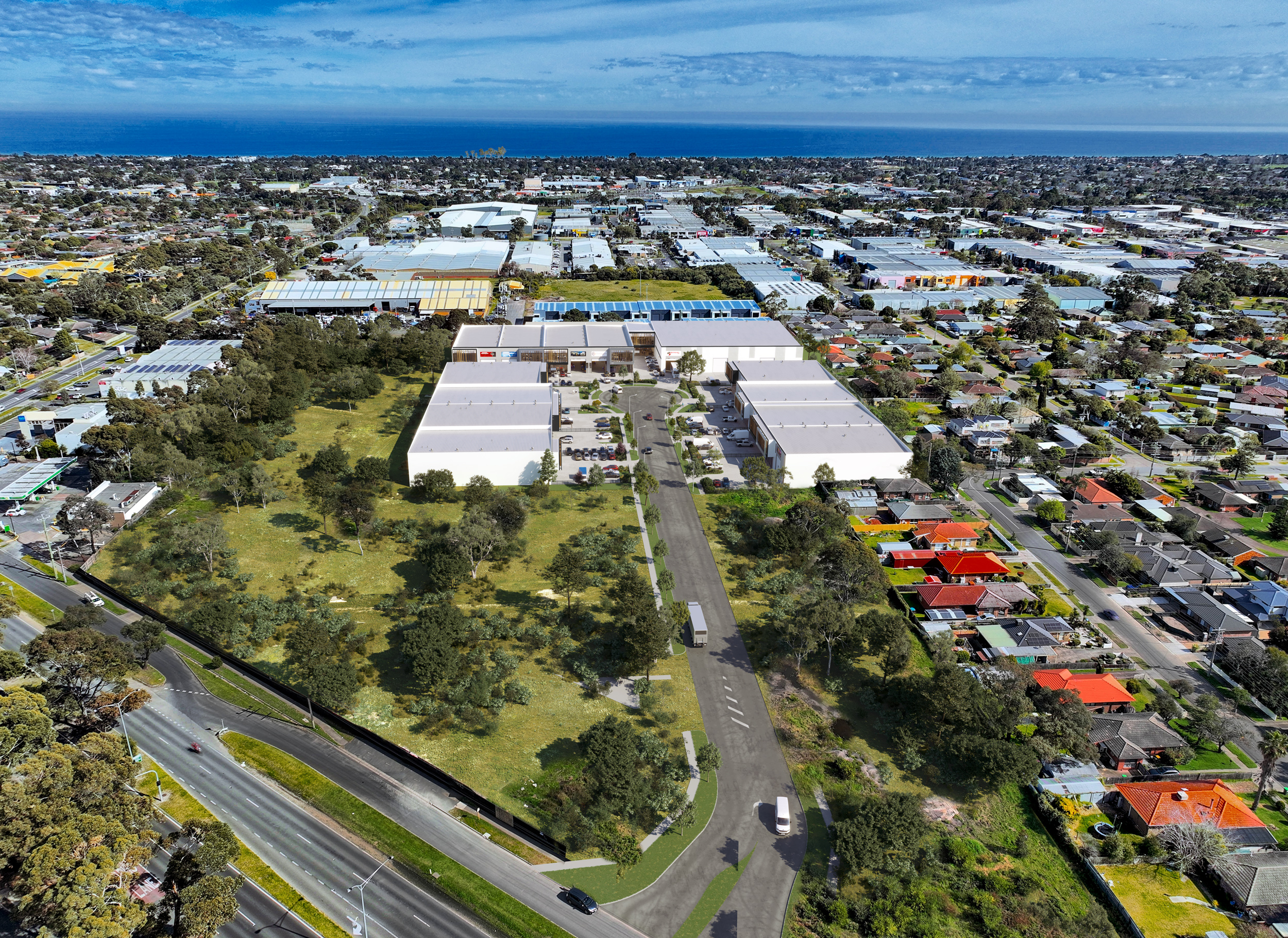
The hero image needs to carry real information. For an estate, that may be an aerial view. For a smaller warehouse project, a strong front elevation or oblique angle may work better.
The choice should be based on what the buyer most needs to understand first, not simply which render looks the most dramatic.
This should be treated as a project-control issue as much as a marketing issue. Decisions need an owner, a current source document and a process for communicating changes. Once the campaign is public, even a small inconsistency can spread through portals, PDFs, agent emails and saved buyer documents, making later corrections much harder than getting the source information right in the first place.
There is also a sequencing issue. The information most useful at first contact is not always the information needed at contract or lease stage. The public campaign should establish the commercial case quickly, while the deeper project pack supports the next step. Mixing those layers can make the first interaction unnecessarily dense and still leave serious prospects without the detail they need later.
Coordinate listings, EDMs, signage and social material
Launch channels should reinforce each other. The same naming, areas, hero visuals and key claims should appear across agent listings, project website, email campaigns, signage and social material.
Minor design variation is fine; factual variation is not.
The highest-value elements are usually the project name, product type, one strong visual, one or two genuine commercial hooks and a clear contact path. Everything else can live on the website or with the agent.
Developers should also decide which questions are best answered publicly and which are better handled by the appointed agent. Publishing everything can remove useful sales conversations, while publishing too little creates low-quality enquiries. The right balance depends on the complexity of the project, the sophistication of the target market and how much flexibility remains in the deal.
Plan the first construction update before launch
A campaign can lose energy if nothing changes for months after the launch.
Know what the next update will be: civil commencement, slab pour, structural steel, road works or a meaningful sales milestone. That creates a natural second wave of communication.
The marketing plan should be checked against how an experienced buyer will interrogate it. Can they understand the entry, circulation, orientation and adjoining lots without opening the civil set? Can they reconcile unit numbers with the price schedule? Can an agent describe a specific opportunity while looking at the same document as the buyer? Those are practical tests of whether the plan is working as a sales instrument.
Small factual errors become disproportionately damaging in commercial property because the same information is repeated in many places. An incorrect area can appear in a render label, brochure, listing, EDM and price schedule before anybody notices. For that reason, source data should be treated almost like project documentation: controlled, dated and updated deliberately rather than copied casually between files.
Set a process for price and availability changes
The project should not rely on someone remembering to email every supplier when a unit sells.
Define who owns availability, who approves price changes and which campaign assets must be updated when the commercial position changes.
Where pricing is intentionally withheld, the enquiry process needs to compensate. Agents should be ready with guidance, a clear qualification process and enough product information to make the conversation useful. Hiding price without improving the sales conversation simply adds another step between the buyer and a decision.
Conversely, if enquiries are consistently unqualified, the issue may be the campaign itself. Vague messaging often attracts everyone while helping nobody self-select. Clearer product definition can reduce enquiry volume while improving the commercial value of every lead that remains.
Measure enquiry quality, not just quantity
The first month should reveal whether the campaign is reaching the right people.
Track what prospects are asking about, which units attract attention, where enquiries come from and how many progress to inspections, meetings, proposals or contracts.
Market response should be separated into awareness, qualification and conversion. High website traffic with weak enquiries suggests a different problem from strong enquiries that do not progress past pricing. Likewise, repeated interest in one unit size can reveal product demand that raw enquiry totals hide. Looking at the funnel properly prevents the development team from treating every slow period as a media problem.
Conversion should be considered separately from lead generation. If qualified prospects are requesting plans and speaking with agents but not progressing, the campaign may already have done its job. At that point the development team needs to inspect price, deal structure, timing, specification or product-market fit instead of assuming the answer is a larger advertising budget.
Treat repeated objections as useful evidence
If multiple prospects push back on the same issue, record it.
A problem with access, office ratio, parking, price, timing or title may require a project response rather than a copy rewrite. Launch feedback is often commercially valuable because it arrives early.
The value of marketing data is in the decisions it informs. If buyers consistently ask for more yard, fewer offices or a different unit size, that feedback may influence later stages. If prospects understand the product but reject the commercial terms, the development team can stop wasting money trying to solve the wrong problem with more promotion.
Conversely, if enquiries are consistently unqualified, the issue may be the campaign itself. Vague messaging often attracts everyone while helping nobody self-select. Clearer product definition can reduce enquiry volume while improving the commercial value of every lead that remains.
Avoid launching before the agents can actually transact
Interest decays quickly when prospects cannot obtain contract information, lease terms, price guidance or meaningful next steps.
Marketing should not get months ahead of the commercial readiness of the project. Awareness is useful, but a launch is most valuable when serious interest can move.
The agent handover should be treated as an operational step, not simply an email containing finished artwork. Walk the agents through the current plans, product hierarchy, known design assumptions, availability process and where to find the latest files. That reduces the chance of different agents describing the same project differently and gives the marketing team early feedback on questions the campaign has not yet answered.
There is also a sequencing issue. The information most useful at first contact is not always the information needed at contract or lease stage. The public campaign should establish the commercial case quickly, while the deeper project pack supports the next step. Mixing those layers can make the first interaction unnecessarily dense and still leave serious prospects without the detail they need later.
Use momentum without overselling it
Early sales, leases and expressions of interest can strengthen confidence in the project.
Communicate real momentum, but do not turn every enquiry into a claimed commitment. Experienced commercial buyers and agents recognise the difference.
The commercial test is whether the information helps a qualified prospect make a better decision. If it does not improve understanding, comparison, confidence or the next step in the transaction, it probably does not deserve much space in the campaign.
Developers should also decide which questions are best answered publicly and which are better handled by the appointed agent. Publishing everything can remove useful sales conversations, while publishing too little creates low-quality enquiries. The right balance depends on the complexity of the project, the sophistication of the target market and how much flexibility remains in the deal.
What a proper launch should achieve
A good launch gives the market a clear, credible and coordinated first view of the development.
It should reduce uncertainty, give agents strong material and create a base that can be updated through the rest of the project rather than replaced every few months.
This should be treated as a project-control issue as much as a marketing issue. Decisions need an owner, a current source document and a process for communicating changes. Once the campaign is public, even a small inconsistency can spread through portals, PDFs, agent emails and saved buyer documents, making later corrections much harder than getting the source information right in the first place.
There is also a sequencing issue. The information most useful at first contact is not always the information needed at contract or lease stage. The public campaign should establish the commercial case quickly, while the deeper project pack supports the next step. Mixing those layers can make the first interaction unnecessarily dense and still leave serious prospects without the detail they need later.
The launch should leave room for the campaign to mature
A launch is the beginning of the market conversation, not the finished state of the campaign. The first serious enquiries will usually expose questions that were not obvious inside the project team. Build enough flexibility into the website, IM, plans and campaign structure that useful market feedback can be incorporated without making the project look unstable.
That is also why the launch pack should avoid unnecessary complexity. The more bespoke pieces that have to be changed independently, the slower the campaign becomes when the development moves. A coordinated system lets the developer respond quickly while keeping the public story controlled.
Commercial Property Marketing works with developers and appointed agents to build that launch system before the first campaign goes live.
More commercial property marketing resources
Explore Commercial Property Marketing, 3D Renders and Commercial Property Insights.


 EXPLORE THE WORK