


Share
Menu
me
nu .
nu .
The Data Centre Land Rush: How AI Is Reshaping Australian Industrial Property
Tags :
August, 2026
The Data Centre Land Rush: How AI Is Reshaping Australian Industrial Property
Australia’s next industrial boom isn’t warehouses — it’s AI space
For decades, the fundamentals of industrial property were relatively straightforward.
Developers looked for land close to motorways, ports, airports, major population centres and freight networks. Occupiers wanted efficient warehouses, truck access, labour and reasonable rents.
Artificial intelligence is beginning to change that equation.
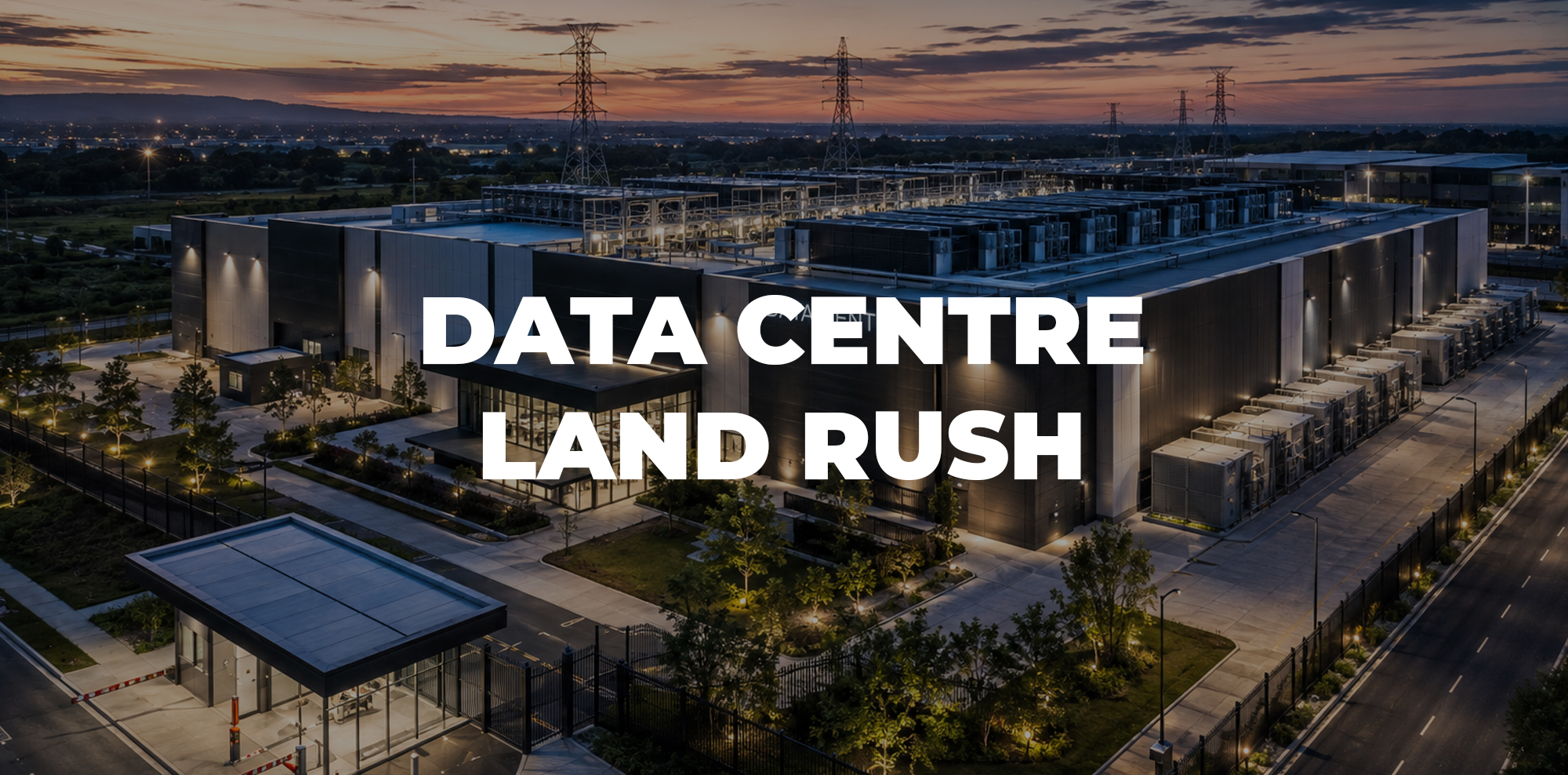
Australia is entering a major expansion phase for data centres and AI infrastructure, and the scale of investment now being proposed is large enough to influence industrial land markets in its own right.
Data Centres Australia forecasts approximately $26 billion of data centre investment nationally by 2030, while the NSW Government’s Investment Delivery Authority alone is currently supporting 15 data centre projects worth approximately $51.9 billion.
Some industry estimates put the broader Australian development pipeline considerably higher.
The key point for commercial property is not simply that more data centres are being built.
It is where they can be built.
Modern AI infrastructure requires access to enormous amounts of electricity, fibre connectivity, water or alternative cooling systems, secure land, transmission infrastructure and planning certainty.
That means the most valuable industrial site of the future may not necessarily be the one beside the motorway.
It may be the one beside the power.
Australian data centre market snapshot
- AI and cloud computing are accelerating demand for new Australian data centre capacity.
- Data Centres Australia forecasts approximately $26 billion in sector investment by 2030.
- NSW’s Investment Delivery Authority is supporting 15 data centre projects valued at approximately $51.9 billion.
- Sydney and Melbourne remain Australia’s dominant data centre markets.
- Western Sydney is developing into one of Asia-Pacific’s major digital infrastructure clusters.
- Brisbane, Perth, Canberra and Adelaide also host established data centre infrastructure.
- New hyperscale projects can require hundreds of megawatts of electrical capacity.
- Proposed campuses are increasingly being measured in gigawatts rather than megawatts.
- Access to electricity is becoming one of the most important industrial site-selection criteria.
- Data centres are beginning to compete with logistics, manufacturing and residential development for strategically located land.
- Water, grid capacity and community impact are becoming increasingly important planning issues.
- Governments are moving toward requiring major data centre developers to contribute directly to new energy infrastructure.
Why AI changes the property equation
Traditional cloud computing already required large data centres.
AI requires significantly more.
Training and operating increasingly sophisticated artificial intelligence models requires enormous computing power concentrated into high-density facilities.
That means more:
- Servers.
- GPUs.
- Cooling.
- Electricity.
- Network infrastructure.
- Backup power.
- Land.
- Capital.
The physical building itself is only one part of the equation.
For a major hyperscale data centre, the ability to secure sufficient electrical capacity can be far more valuable than the warehouse-style structure eventually constructed on the site.
This fundamentally changes industrial site selection.
For logistics, the question might be:
How quickly can a truck reach the motorway?
For data centres, the question increasingly becomes:
How many megawatts can this site actually secure — and when?
Power is becoming the new industrial land currency
This may be the most important commercial property consequence of Australia’s AI boom.
Two industrial sites may appear almost identical.
They may have:
- Similar zoning.
- Similar land area.
- Similar motorway access.
- Similar surrounding development.
- Similar land values.
But if one has access to 200MW of electrical capacity and the other cannot secure a meaningful grid connection for several years, their potential values to a data centre operator could be completely different.
Power availability is therefore becoming an embedded property characteristic.
In the same way waterfront access can influence marine property and rail sidings can influence freight property, access to high-capacity electricity infrastructure could increasingly influence industrial land value.
Developers are therefore paying greater attention to:
- Substations.
- Transmission corridors.
- Renewable Energy Zones.
- Grid connection capacity.
- Fibre networks.
- Water infrastructure.
- Future electricity augmentation.
This creates an entirely new way of identifying strategic industrial land.
Australia’s major data centre land rush is already underway
Sydney and Melbourne remain at the centre of the Australian market, but activity is spreading.
Equinix currently operates Australian data centre infrastructure across Sydney, Melbourne, Perth, Brisbane, Canberra and Adelaide, illustrating how widely distributed the digital economy has already become.
The next wave, however, is substantially larger.
Projects are increasingly being developed as campuses rather than individual facilities.
Instead of a single building, developers are planning:
- Multiple data halls.
- Dedicated substations.
- Private electrical infrastructure.
- Backup generation.
- Cooling infrastructure.
- Secure internal roads.
- Large-scale fibre connections.
This begins to resemble infrastructure development as much as conventional property development.
Western Sydney becomes Australia’s data centre capital
No Australian commercial property market is being affected more dramatically than Western Sydney.
The region already contains a major concentration of cloud and digital infrastructure.
Now a new generation of hyperscale developments is emerging across areas including:
- Kemps Creek.
- Eastern Creek.
- Erskine Park.
- Huntingwood.
- Blacktown.
- Marsden Park.
- Guildford West.
The reasons are relatively straightforward.
Western Sydney offers combinations of:
- Large industrial sites.
- Major transmission infrastructure.
- Population scale.
- Fibre connectivity.
- Motorway access.
- Existing logistics development.
- Proximity to Sydney.
- Significant future infrastructure.
That has positioned the region at the centre of Australia’s AI infrastructure investment boom.
Mamre Road: industrial development moves into the gigawatt era
One of the clearest examples is the proposed Mamre Road Data Centre Campus in Western Sydney.
The NSW Planning Portal describes a proposed campus with approximately 1GW of power capacity, comprising six four-storey data centre buildings, 936 cooling units and associated infrastructure.
One gigawatt is an extraordinary amount of power for a single property development.
It demonstrates just how different the next generation of industrial infrastructure is becoming.
A conventional warehouse developer primarily deals with:
- Land.
- Buildings.
- roads.
- services.
A gigawatt-scale data centre requires coordination with the electricity system at a fundamentally different level.
This is one reason access to transmission and generation infrastructure is becoming critical to industrial development strategy.
Project Pluto demonstrates pressure on established industrial sites
Another major proposal is Project Pluto at 132 McCredie Road, Guildford West.
The State Significant Development application proposes a major data centre on the former Castrol industrial site.
Importantly, the NSW Planning Portal currently lists the application as “More Information Required”, meaning the proposal remained under assessment rather than being finally approved at the time of writing.
That distinction matters.
Australia’s data centre pipeline contains billions of dollars of projects, but proposed capacity should not automatically be treated as committed capacity.
Projects still need to secure:
- Planning approvals.
- Power.
- Water.
- Construction funding.
- Customers.
- Grid connections.
Nevertheless, Project Pluto demonstrates another major property trend.
Existing industrial land is being repositioned for significantly higher-value digital infrastructure.
Existing industrial estates may become data centre estates
This creates a fascinating challenge for traditional industrial property.
Well-located employment land has historically supported:
- Warehousing.
- Manufacturing.
- Automotive uses.
- Transport.
- Trade businesses.
Data centres can potentially outbid many traditional industrial users because the underlying economics are completely different.
A logistics tenant measures property cost against warehouse operations.
A hyperscale technology company may be deploying billions of dollars of computing equipment within the facility.
Land becomes a relatively small component of the overall project.
That could allow data centre developers to pay premiums for strategically important sites.
The consequence may be rising land values around infrastructure-rich industrial precincts.
Melbourne’s data centre footprint is spreading
Melbourne is experiencing a similar transformation.
Historically, data centre development has concentrated around established technology and industrial precincts.
But increasingly large sites are now being pursued farther from the CBD.
A significant proposal at 45 Donnybrook Road, Mickleham entered Victoria’s Development Facilitation Program during 2026.
The Victorian Government’s permit register confirms an application for the use and development of a data centre at 45 Donnybrook Road.
Industry reporting indicates the proposal could involve multiple large data centre buildings across a site of approximately 67 hectares.
Again, this was a planning application rather than a completed approval at the time of review.
But the location is highly significant.
Mickleham sits well beyond Melbourne’s traditional inner industrial market.
This suggests future data centre development may increasingly follow electricity infrastructure rather than existing warehouse precincts.
Data centres could create entirely new industrial corridors
This is where the property story becomes particularly interesting.
If electrical capacity becomes the dominant constraint, the next data centre corridors may emerge in places currently regarded as secondary industrial markets.
A site could become strategically important because it sits near:
- A major substation.
- A transmission line.
- Renewable generation.
- Large-scale battery infrastructure.
- Fibre.
- Available water infrastructure.
That could shift development pressure into areas that previously lacked sufficient demand for premium industrial development.
The arrival of a major data centre can then attract additional investment.
This includes:
- Electrical contractors.
- Technology businesses.
- Maintenance providers.
- Equipment suppliers.
- Security companies.
- Construction companies.
- Engineering businesses.
Digital infrastructure can therefore create an employment ecosystem around itself.
Why Sydney and Melbourne still dominate
Data centres cannot simply be built anywhere electricity is available.
Connectivity matters.
Latency — the time required for information to travel between users and servers — remains extremely important.
Large population centres therefore retain major advantages.
Sydney and Melbourne offer:
- Large concentrations of customers.
- International fibre connectivity.
- Cloud ecosystems.
- Skilled labour.
- Existing data centre infrastructure.
- Financial markets.
- Enterprise users.
This means Australia’s largest cities will remain critical.
However, the footprint within those cities may continue shifting outward toward areas where sufficient land and energy infrastructure can be secured.
Brisbane could become a major secondary market
Brisbane is another market worth watching closely.
The city benefits from:
- Rapid population growth.
- Major corporate demand.
- Substantial industrial corridors.
- Renewable energy investment across Queensland.
- International subsea connectivity.
- Expanding digital economy.
The wider South East Queensland industrial market also contains significantly more developable land than inner Sydney.
This could become increasingly important as hyperscale operators search for alternatives to constrained east-coast markets.
Potential future areas of interest include industrial corridors where electricity infrastructure, land and fibre intersect.
For property developers, this creates a new category of due diligence.
It is no longer sufficient to ask:
Is the land industrial zoned?
The next question may be:
How much power can we secure?
Perth’s energy economy creates another opportunity
Perth may also become increasingly important.
Western Australia combines:
- Major energy resources.
- Large industrial landholdings.
- Renewable energy potential.
- International connectivity.
- Mining technology.
- Growing cloud demand.
The city already has established data centre infrastructure.
Over time, Western Australia’s abundance of land and energy could provide advantages for large compute infrastructure.
However, power reliability, transmission infrastructure and connectivity will continue influencing where development is feasible.
Canberra remains strategically important
Canberra’s data centre market serves a different purpose.
Government, defence, intelligence and cybersecurity create strong demand for secure domestic computing infrastructure.
Data sovereignty is increasingly important.
Some workloads cannot simply be located offshore.
This creates continued demand for highly secure Australian data centres capable of serving:
- Federal government.
- Defence.
- Critical infrastructure.
- Financial institutions.
- Health systems.
Canberra therefore remains an important specialist market even if it does not reach Sydney’s hyperscale volumes.
Data centres are starting to compete with logistics for land
For industrial property owners, this may be one of the most important consequences.
Many of the attributes required by hyperscale data centres overlap with logistics requirements.
Both prefer:
- Large sites.
- Industrial zoning.
- Separation from residential areas.
- Major infrastructure.
- Secure access.
- Metropolitan locations.
But data centres place far greater emphasis on electricity and fibre.
In some precincts this could create direct competition.
A 20-hectare site that might once have become a logistics estate could instead become a data centre campus.
That reduces the amount of land available for conventional warehousing.
Ironically, the data centre boom could therefore tighten industrial land supply even for businesses that have nothing to do with technology.
Could AI push industrial land values higher?
Potentially.
But the effect will be highly location-specific.
A hyperscale operator does not simply need industrial land.
It needs power-enabled industrial land.
Sites meeting that requirement are relatively scarce.
Where multiple operators compete for limited infrastructure capacity, developers may be prepared to pay substantial premiums.
This could create a new category within industrial valuation:
MW per hectare.
Not formally, perhaps, but economically the concept is already becoming relevant.
The ability of a site to accommodate electrical load could materially alter its highest and best use.
Governments are beginning to respond
The scale of proposed development is now large enough that governments are developing dedicated policy responses.
In March 2026, the Australian Government released national expectations for data centres and AI infrastructure developers.
The expectations cover five broad areas:
- Australia’s national interest.
- Energy transition.
- Sustainable water use.
- Australian skills and employment.
- Research and innovation.
Most importantly for property development, the government expects data centre operators to underwrite new renewable electricity supply and pay their full share of grid connection costs, rather than passing those costs to other electricity consumers.
This is a major change in the development equation.
The future data centre developer may effectively need to develop energy infrastructure alongside property.
Social licence is becoming a planning issue
The enormous scale of data centres also creates community concerns.
Major facilities can involve:
- Significant electricity consumption.
- Water use.
- Backup generators.
- Cooling plant.
- Noise.
- Large structures.
- Electrical substations.
Government policy increasingly refers to a sector’s social licence to operate.
That means community engagement will become increasingly important.
The best sites may therefore be locations where digital infrastructure can operate without conflicting with surrounding residential development.
Again, this strengthens the value of strategic employment land.
Water could become almost as important as electricity
Cooling large amounts of computing equipment generates significant heat.
Historically, many data centres have relied partly on water-based cooling.
But water security is increasingly becoming a planning issue.
A 2026 NSW parliamentary inquiry received evidence discussing significant future expenditure on recycled-water infrastructure to service data centre demand.
Developers are therefore likely to face increasing pressure to use:
- Recycled water.
- Closed-loop cooling.
- Air cooling.
- More efficient cooling technology.
For commercial property, this means access to recycled-water networks could potentially become another site advantage.
Data centres could help fund Australia’s energy transition
There is another side to the argument.
Data centres are enormous energy consumers, but they are also enormous capital investors.
If operators are required to underwrite new renewable generation, they could accelerate investment in:
- Solar.
- Wind.
- Batteries.
- Transmission.
- Grid infrastructure.
The federal government’s stated expectation is that data centres should support rather than obstruct Australia’s energy transition.
That creates the possibility of integrated development models combining:
renewable energy + storage + transmission + data centres.
If that happens, some of Australia’s next major industrial precincts may look very different from traditional warehouse estates.
Bought & Sold: data centre land becomes an investment asset in its own right
The data centre boom is also changing land transactions.
Rather than purchasing completed income-producing property, major technology and infrastructure investors are increasingly acquiring strategic land years ahead of development.
The attraction lies in securing:
- Land control.
- Power capacity.
- Planning pathways.
- Grid access.
- Expansion capacity.
Large metropolitan sites capable of accommodating digital infrastructure can therefore command values difficult to compare with conventional industrial land.
This presents both opportunity and risk.
A site with genuine access to power may become extraordinarily valuable.
A site marketed as “data-centre capable” without confirmed electrical capacity may be little more than speculative land.
Developers need to distinguish between the two.
Development Applications, Approvals & Projects Progressing Through Planning
Australia’s data centre pipeline is now sufficiently large that planning activity itself has become a useful measure of industrial demand.
Major proposals currently progressing include:
Mamre Road Data Centre Campus, Western Sydney
A proposed 1GW campus involving six major data centre buildings and extensive associated infrastructure.
Project Pluto, Guildford West
A major Western Sydney proposal currently listed by the NSW Planning Portal as requiring additional information during assessment.
45 Donnybrook Road, Mickleham
A major Victorian data centre application progressing through the state’s Development Facilitation Program.
These projects demonstrate the geographic expansion of the sector and the scale of capital being considered.
What industrial developers should start doing now
The data centre boom does not mean every industrial developer should start building data centres.
But it does mean developers should understand whether their land has characteristics valuable to the sector.
For strategic industrial holdings, due diligence should increasingly include:
- Available electrical capacity.
- Distance to major substations.
- Transmission infrastructure.
- Grid connection timelines.
- Fibre availability.
- Water infrastructure.
- Planning restrictions.
- Noise separation.
- Expansion potential.
This information could materially change the development strategy for a site.
What landowners should watch
Owners of large industrial landholdings should be particularly careful before selling.
A property that appears to be conventional employment land today could possess strategic infrastructure characteristics that significantly increase its value.
Questions worth asking include:
- Is there a major substation nearby?
- Does transmission infrastructure cross the area?
- Is the site close to fibre routes?
- Could a large electrical connection be achieved?
- Are technology or infrastructure investors acquiring nearby land?
- Is the planning framework compatible with data centre development?
In some cases, answering these questions before going to market could materially alter the site’s positioning.
The next industrial hotspot may not look like an industrial hotspot
This is perhaps the biggest takeaway.
Australia’s next major industrial property growth corridor may not emerge because a new motorway has opened.
It could emerge because a new substation has been built.
Or because renewable generation connects to the grid.
Or because fibre infrastructure passes through an area with large employment-zoned landholdings.
AI is therefore changing the geography of industrial property.
Transport infrastructure remains crucial.
But digital and electrical infrastructure are becoming equally important.
What developers should watch through 2026–27
Several themes will determine how quickly Australia’s data centre land rush accelerates.
- Grid connection availability.
- New renewable energy projects.
- Transmission investment.
- Government planning reforms.
- Water restrictions.
- Community opposition.
- AI computing demand.
- Hyperscale customer commitments.
- Institutional capital entering the sector.
- Industrial land competition.
- Expansion into secondary cities.
- Data sovereignty requirements.
The most important question is likely to remain power.
Australia has plenty of land.
What it does not have everywhere is unlimited electricity capacity.
That bottleneck could determine where billions of dollars of investment ultimately lands.
How AI could permanently change Australian industrial property
Industrial property has already experienced several structural shifts.
Containerisation created logistics precincts.
E-commerce created enormous fulfilment centres.
Automation changed warehouse design.
AI may produce the next transformation.
The physical infrastructure required to power the digital economy is enormous.
And unlike software, it needs real land.
It needs substations.
It needs electricity.
It needs water.
It needs planning approval.
It needs construction.
In other words, the AI revolution is also a property development story.
For developers and landowners, the opportunity lies in recognising that before the broader market does.
Positioning industrial land for the next generation of demand
Commercial Property Marketing works with developers, landowners and commercial agencies to communicate the future potential of industrial land before that potential physically exists.
As industrial property becomes increasingly infrastructure-driven, clearly demonstrating those advantages becomes even more important.
The objective is to:
- Increase the perceived and realised value of strategic industrial land.
- Communicate power, transport and infrastructure advantages clearly.
- Position development sites for emerging occupier sectors.
- Help investors understand future highest-and-best-use potential.
- Demonstrate complex estates and infrastructure before construction.
- Generate stronger enquiry from national and institutional buyers.
- Give commercial agents better material to explain strategic opportunities.
- Differentiate land that may otherwise appear comparable to competing sites.
- Improve stakeholder understanding of major developments.
- Ultimately extract more value from commercial and industrial property.
Related content
Latest content




Accelerate your project
Whether you’re selling land, securing approvals, or launching a campaign — we’ll help you visualise it clearly and move faster to market. Fill out the form below and we’ll send through a free tailored quote for your next commercial or industrial development.






























01.