Australia’s commercial property market has quietly entered a new phase, and it’s being driven by infrastructure rather than tenants. Firmus’ reported US$10bn funding package for large-scale AI data centre delivery marks one of the most consequential capital injections the sector has seen this cycle. The ambition — up to 1.6GW of AI-focused compute capacity rolled out across Australia — immediately reframes how industrial land, power access, and planning certainty are valued.
This isn’t a speculative technology play. It’s an infrastructure land grab unfolding in real time, and it directly intersects with the same industrial corridors that logistics, manufacturing, and trade users rely on.
Why AI infrastructure is changing commercial land fundamentals
AI data centres differ materially from traditional industrial assets. They don’t just require large parcels — they require exceptional parcels. Power availability, grid resilience, and approval certainty now sit above frontage and even access in the site selection hierarchy.
The implications for commercial property are structural, not cyclical.
Power-enabled land becomes the scarcest commodity in the market, overtaking generic serviced industrial lots
Sites near substations, transmission corridors, or upgradeable grid infrastructure attract strategic premiums
Planning pathways that reduce approval timeframes materially outperform speculative rezonings
Industrial precincts face competition not just on land price, but on energy strategy and servicing readiness
Regional and edge-metro locations rise in relevance as traditional core zones reach capacity constraints
This reweights how value is assessed. Land that previously struggled to differentiate itself suddenly becomes critical infrastructure if it can support AI workloads.
How this shifts behaviour for developers and landowners
The Firmus announcement signals that capital is no longer waiting for “perfect conditions”. Groups with funding certainty are locking in land now and solving constraints in parallel. That creates a first-mover advantage for landowners who can present clarity rather than potential.
Off-market negotiations accelerate as AI operators prioritise certainty over public campaigns
Large-scale landholders become JV partners rather than sellers
Sites with early-stage servicing studies or grid discussions gain immediate leverage
Industrial estates with flexible staging outperform single-outcome developments
Visual proof of scale, access, and buildability becomes essential in early negotiations
For traditional industrial developers, this introduces a new competitor — one that is less rent-sensitive and more timeline-driven.
Flow-on impacts across industrial and logistics markets
AI infrastructure does not exist in isolation. It pulls trades, contractors, logistics providers, security, and maintenance ecosystems into surrounding precincts. That secondary demand has implications for leasing velocity across neighbouring assets.
Increased competition for civil, electrical, and construction labour
Stronger demand for ancillary warehouse, storage, and service assets
Pressure on industrial rents in power-adjacent corridors
Repricing of large contiguous land parcels previously considered “too big”
Greater scrutiny on industrial estates lacking long-term power strategies
This is how infrastructure cycles reshape commercial property — not overnight, but decisively.
Bought / sold signals to watch
Transaction evidence is already reflecting the premium placed on serviced, scalable land.
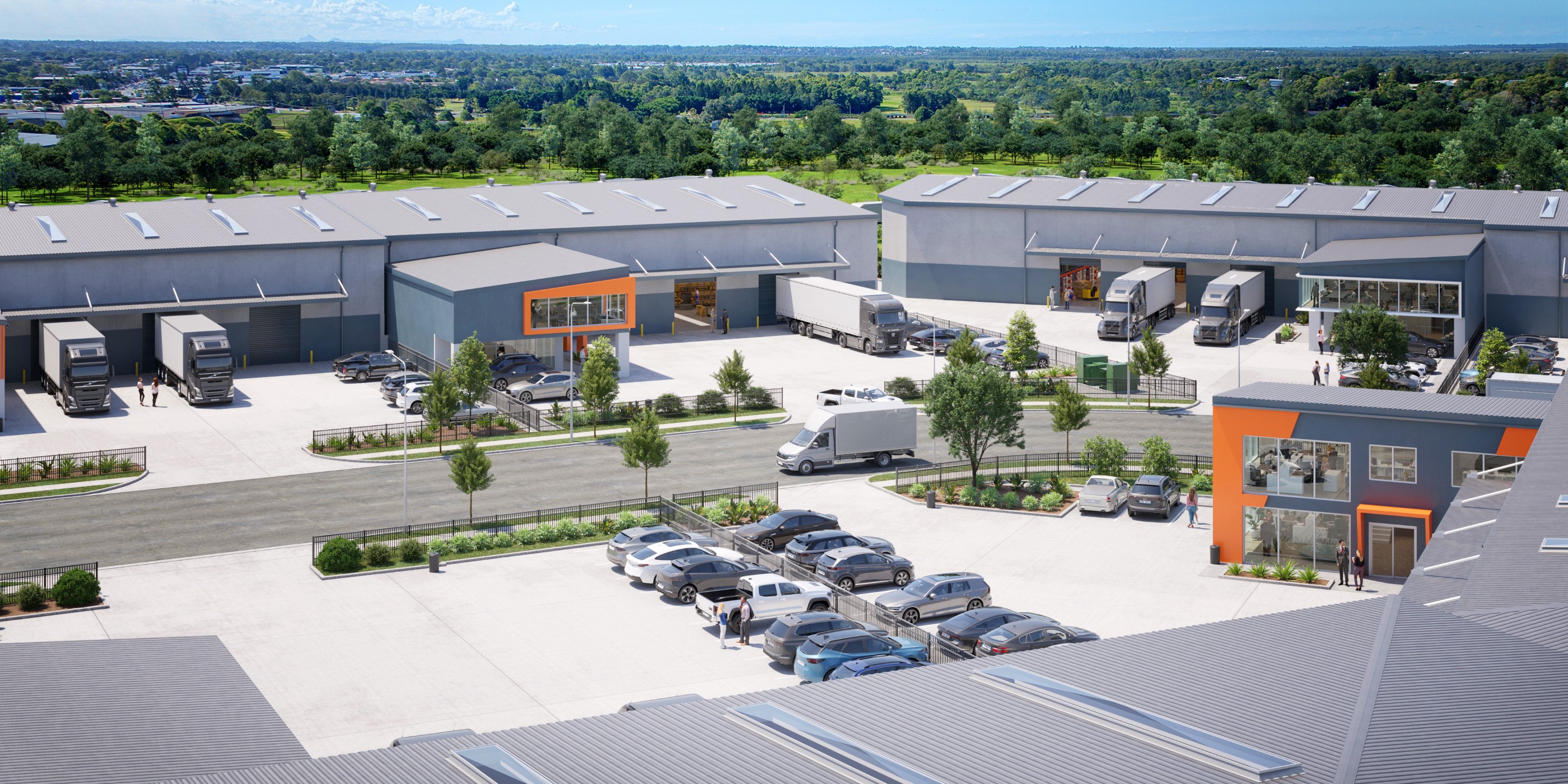
Hub Heathwood – 731 Johnson Road, QLD – circa $92 million sell-out
Twenty-four serviced industrial lots absorbed rapidly, reinforcing how access, services, and delivery timing continue to drive liquidity in Brisbane’s south-west growth corridor.
View Project >
 EXPLORE THE WORK