Interest rates continue to shape almost every part of the commercial property market. Whether rates move up, stabilise or begin falling further through 2026, the impact flows directly into development feasibility, investor behaviour, tenant demand and land values.
But while headlines often focus on residential housing, commercial and industrial property reacts very differently to rate movement.
For developers, landowners and investors, understanding how rate changes affect commercial projects has become critical to making the right timing decisions.
Higher rates change project feasibility fast
One of the biggest impacts of rising interest rates is development feasibility pressure.
When rates increase:
- Holding costs rise
- Construction finance becomes more expensive
- Feasibility margins tighten
- Debt servicing impacts borrowing capacity
- Pre-sale requirements become harder to achieve
- Smaller developers often delay launches
- Industrial land settlements slow
- Speculative construction reduces
This is particularly noticeable across industrial land estates and multi-unit developments where finance exposure is large and projects rely heavily on momentum.
A project that stacked up financially 18 months ago can quickly become marginal once finance costs increase across acquisition, construction and holding periods.
This is why many developers are now placing greater focus on:
- Faster pre-sales
- Earlier leasing campaigns
- Reduced time to market
- Higher enquiry conversion
- Stronger investor presentation
- Better project communication
The clearer the project becomes, the easier it is to reduce hesitation and improve campaign velocity.
Industrial property continues outperforming despite pressure
While higher rates have slowed parts of the market, industrial property has remained surprisingly resilient.
Across many Australian cities:
- Industrial vacancy remains historically low
- Tenant demand continues exceeding supply
- Logistics growth remains strong
- Data centre demand is increasing land competition
- Infrastructure investment continues driving expansion
- Population growth supports warehouse demand
- Rental growth is offsetting some finance pressure
This has created an unusual market where borrowing conditions became harder, but underlying industrial demand stayed strong.
As a result, many developers are still proceeding with projects — but with a much larger focus on campaign quality and pre-market positioning.
Landowners are becoming more strategic
Commercial landowners are also adjusting their strategy based on interest rate movement.
During higher-rate periods:
- Buyers become more selective
- Investors require clearer upside
- Developers become feasibility focused
- Land banking becomes more expensive
- Vacant land takes longer to interpret
- Sites with visual planning gain attention faster
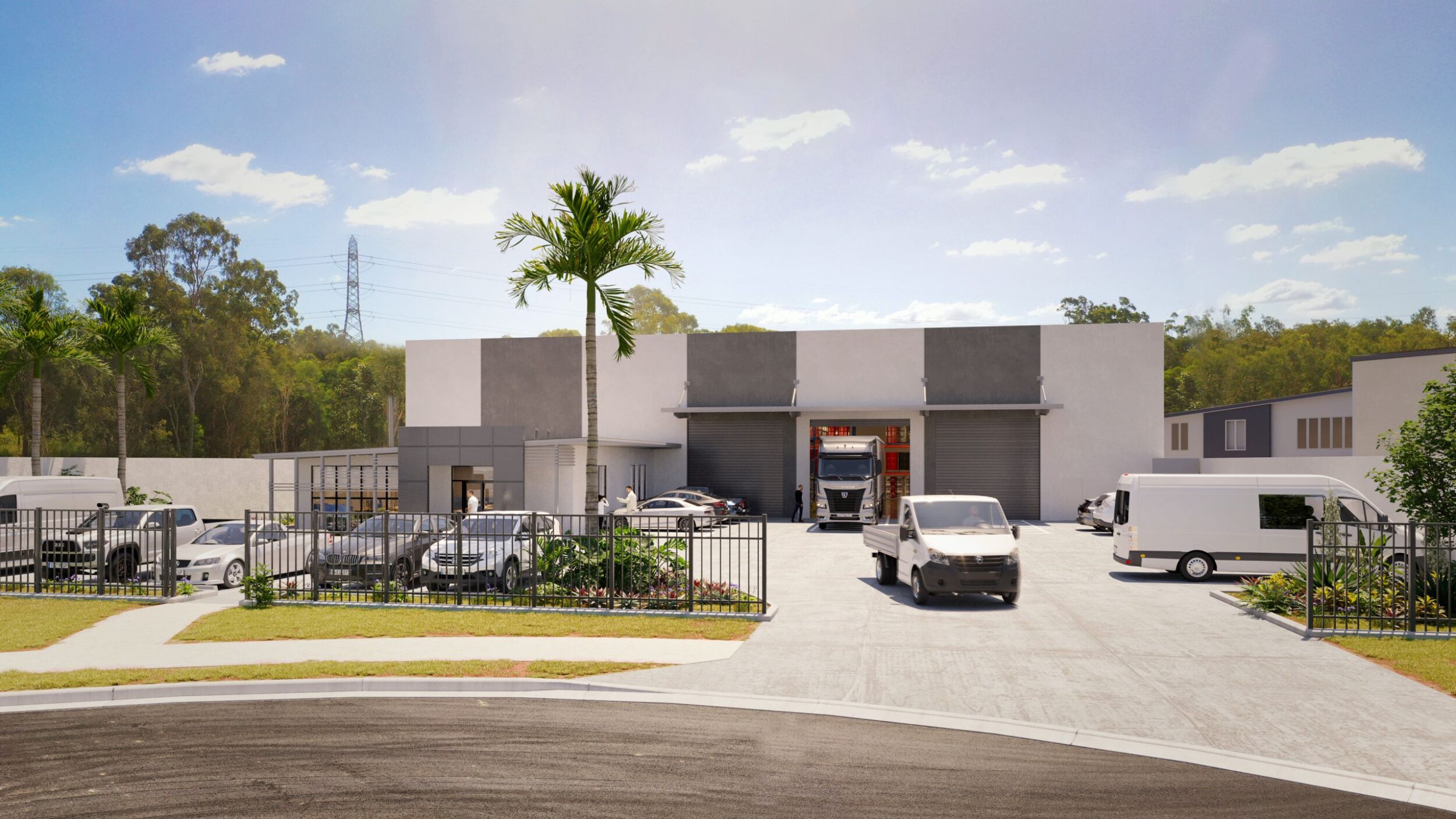
This is one reason visual masterplanning has become increasingly important for englobo and industrial land campaigns.
Instead of selling raw land boundaries alone, owners are now:
- Showing future warehouse outcomes
- Demonstrating subdivision potential
- Presenting circulation layouts
- Highlighting staging opportunities
- Illustrating usable development yield
- Positioning sites toward specific industries
The objective is simple — reduce interpretation and increase perceived opportunity.
Falling rates could trigger another industrial acceleration cycle
If rates continue easing through late 2026 and into 2027, many analysts expect another strong acceleration phase across industrial and commercial property.
Lower rates typically improve:
- Borrowing confidence
- Development feasibility
- Investor activity
- Acquisition appetite
- Commercial lending
- Business expansion
- Pre-commitment activity
This could rapidly increase competition for:
- Serviced industrial land
- Logistics sites
- Urban infill industrial assets
- Trade-based commercial units
- Industrial strata developments
- Well-connected transport corridors
Markets already experiencing supply shortages could tighten even further once cheaper finance returns.
Developers are now prioritising speed to market
Because market conditions can shift quickly, developers are placing much larger emphasis on reducing campaign delays.
The projects gaining momentum fastest are usually those that:
- Launch visually prepared
- Have strong digital presentation
- Clearly communicate end outcomes
- Explain access and usability
- Reduce buyer interpretation
- Create confidence early
- Support pre-sales before construction
This is where visual-first marketing has become less of a design exercise and more of a financial strategy.
Every month saved during pre-sales or leasing can materially affect:
- Finance exposure
- Holding costs
- Feasibility outcomes
- Construction timing
- Investor confidence
- Debt pressure
The faster a project becomes understood, the faster decisions happen.
Commercial property is becoming more presentation driven
Interest rate pressure has exposed a major divide in the market.
Projects with weak presentation are slowing down.
Projects with strong clarity are still generating enquiry.
Buyers are becoming more cautious, which means campaigns now need to work harder to create confidence.
This is why commercial property marketing is increasingly shifting toward:
- Real-site visualisation
- Aerial 3D masterplans
- Motion-tracked drone showcases
- Interactive sales systems
- Digital-first campaigns
- Stronger leasing presentation
- Faster project understanding
The market is no longer rewarding projects simply for existing.
It is rewarding projects that become understood quickly.
How Commercial Property Marketing can help
At Commercial Property Marketing we help commercial and industrial projects improve market performance before construction even begins.
Our campaigns are built to support:
- Land value optimisation
- Secure early leasing
- Faster pre-sales momentum
- Stronger investor confidence
- Higher perceived project value
- Reduced buyer hesitation
- Faster market understanding
- Earlier enquiry generation
- Better stakeholder alignment
- Improved campaign clarity
The objective is simple — turn development into demand by helping projects become understood instantly.

 EXPLORE THE WORK